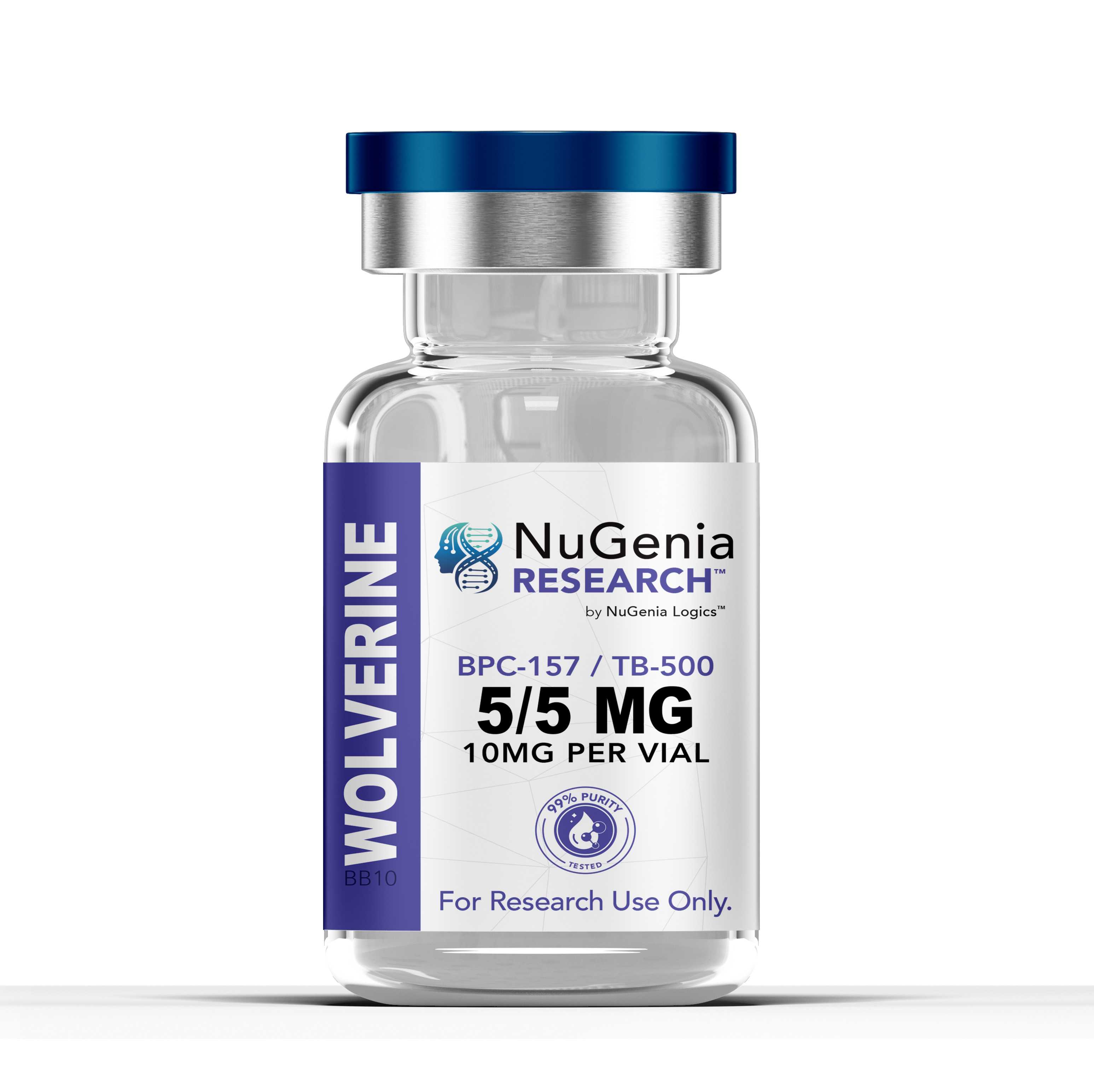
Description
2
Peptides, co-lyophilized
≥99%
HPLC-verified purity
10 mg
Total peptide (5 + 5)
30+ yrs
Published research
Molecular Breakdown
What’s inside the Wolverine blend
Two independently synthesized, HPLC-purified research peptides — BPC-157 and TB-500 — co-lyophilized into a single vial. Full molecular profiles below.
1
BPC-157
Aliases: Body Protection Compound-157 · Pentadecapeptide · PL 14736
A synthetic 15-amino-acid peptide patterned on a sequence found in gastric juice, studied in preclinical models for angiogenesis and tissue-level repair.
TypePentadecapeptide (15 aa)
SequenceGly-Glu-Pro-Pro-Pro-Gly-Lys-Pro-Ala-Asp-Asp-Ala-Gly-Leu-Val
FormulaC₆₂H₉₈N₁₆O₂₂
Molar mass1419.56 g/mol
CAS137525-51-0
Storage: Lyophilized, store at −20°C, protected from light. Reconstitute with bacteriostatic water; keep reconstituted vials at 2–8°C.
2
TB-500
Aliases: Thymosin Beta-4 fragment · Tβ4 actin-binding domain · Ac-LKKTETQ
A synthetic acetylated peptide based on the actin-binding region of Thymosin Beta-4, studied in research settings for cell migration and cytoskeletal remodeling.
TypeAcetylated peptide fragment
Core motifAc-Leu-Lys-Lys-Thr-Glu-Thr-Gln (Ac-LKKTETQ)
FormulaC₃₉H₆₈N₁₀O₁₄
Molar mass889.02 g/mol
CAS885340-08-9
Storage: Lyophilized, store at −20°C, protected from light. Reconstitute with bacteriostatic water; keep reconstituted vials at 2–8°C.
Complementary Pathways
Why BPC-157 and TB-500 are researched together
The pairing (nicknamed “Wolverine”) appears throughout regeneration research because each peptide is associated with a distinct, complementary pathway in the preclinical literature.
BPC-157
Studied for cytoprotection and blood-vessel formation (angiogenesis), often via nitric-oxide-related signaling in tendon, ligament, and gut-tissue models.
TB-500
Studied for actin regulation and cell migration — the cytoskeletal remodeling that lets cells reorganize during wound-closure and tissue-remodeling research.
Research Applications
Where this material is used in the lab
Reported laboratory contexts for the individual compounds and the combination in in-vitro and animal research:
Wound-closure assaysEndothelial & fibroblast migrationAngiogenesis modelsTendon & ligament repair modelsActin/cytoskeletal remodelingSoft-tissue regeneration systems
Selected Research
Published preclinical literature
Peer-reviewed studies on the individual peptides. These are preclinical (cell and animal) studies of the compounds themselves; they do not describe this product or any human use.
Chang C-H, et al. The promoting effect of pentadecapeptide BPC 157 on tendon healing involves tendon outgrowth, cell survival, and cell migration.
J Appl Physiol. 2011;110(3):774–780. PMID 21030672 ↗
Gwyer D, Wragg NM, Wilson SL. Gastric pentadecapeptide body protection compound BPC 157 and its role in accelerating musculoskeletal soft tissue healing.
Cell Tissue Res. 2019;377(2):153–159. PMID 30915550 ↗
Malinda KM, et al. Thymosin β4 accelerates wound healing.
J Invest Dermatol. 1999;113(3):364–368. PMID 10469335 ↗
Philp D, et al. Thymosin β4 and a synthetic peptide containing its actin-binding domain promote dermal wound repair in db/db diabetic mice and in aged mice.
Wound Repair Regen. 2003;11(1):19–24. doi:10.1046/j.1524-475X.2003.11105.x ↗
Citations are provided for scientific reference only and do not constitute claims about this product.
🧪
Backed by a lot-matched Certificate of Analysis
Every Wolverine order is tied to a COA quantifying both compounds against the exact lot in your vial — HPLC purity and identity by mass spectrometry.
View COAs →
⚠️ For Research Use Only. This product is sold exclusively as reference material for in-vitro laboratory and educational research. It has not been evaluated by the FDA and is not intended for human or veterinary use, consumption, diagnosis, treatment, or to prevent any disease. Note: BPC-157 and TB-500 are prohibited in sport (WADA S0).