
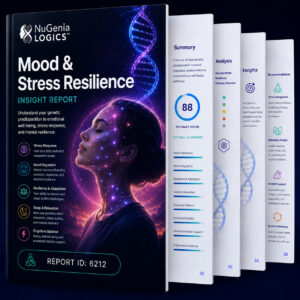

Mood & Stress Resilience Insight Report

Original price was: $49.Current price is: $29.

Mood & Stress Resilience

What does your DNA say about how you hold up under pressure?

Five validated markers across oxytocin signaling, circadian timing, neuroplasticity, melatonin response and stress-chemical clearance — read from the raw DNA file you already have, and scored against the compounds studied in this pathway. Not guessed.

$29 $49Save $20

One-time payment · digital delivery · no subscription

Get My Mood & Stress Report

5 markers · 5 resilience systems Uses your existing DNA data No new DNA test required

NuGenia Logics · Molecular Insight Engine

Mood & Stress Resilience

Sample · anonymized

34/ 100

Peptide relevance

Low alignment. Few of this member’s variants match the compounds studied here — and the report says plainly that what will move the needle for them is sleep, exercise and not withdrawing under stress.

Peptide alignment · 4 compounds scored

Semaxrs6265 · BDNFModerate
DSIPsingle-marker evidenceLow
Oxytocinno supporting markersNone
Selankno supporting markersNone
5Markers matched
LowAlignment tier
RPT‑6212Report

Your DNA

Analyzed from the raw file you already have.

Your Pathways

Five markers mapped to mood and stress biology.

Your Report

Scored, explained, and delivered digitally.

The questions it answers

Most stress advice is written for a population. This one is written for a genome.

Four questions about how you are built to handle pressure — not whether something is wrong with you, and not a risk score for any condition. The answers are already in the file you downloaded from your DNA testing service.

Stress chemistry

Am I steadier in a crisis, or steadier in the quiet?

COMT at rs4680 sets how fast you clear dopamine and adrenaline from the prefrontal cortex. Fast clearers tend to hold composure under acute pressure but can feel flat when under-stimulated. Slow clearers get the opposite trade. Neither is better — but knowing which you are changes how you should structure a demanding week.

COMT rs4680Val158Met

Social buffering

Does connection buffer my stress automatically, or do I have to work at it?

OXTR at rs53576 is the oxytocin receptor — the system behind social bonding and the calming effect other people can have on a stress response. Variation here is studied in relation to how much benefit comes automatically versus how much has to be built deliberately.

OXTR rs53576Oxytocin receptor

Plasticity & rhythm

What does my recovery actually depend on?

BDNF at rs6265 governs activity-dependent release of the protein behind learning and adaptation — and it is the marker most responsive to aerobic exercise. CLOCK and MTNR1B set your circadian timing. Mood stability is built on sleep and rhythm far more than most people expect.

BDNF rs6265CLOCK rs1801260

Peptide alignment

Do the mood-related peptides match my biology?

This is the section most people buy the report for. Four compounds studied in this pathway are scored against your markers — and the sample below scores 34, the lowest we have published, with two of the four returning no alignment at all.

4 compounds scored+ full alignment table

See the report

See what your report actually looks like

This isn’t a mental-health assessment and it does not screen for any condition. It’s a personalized analysis of your genetic markers and how they relate to stress chemistry, social buffering and circadian rhythm — and everything on the right is lifted from a real delivered report.

Your report includes:

  • Peptide relevance score out of 100
  • Plain-language pathway summary
  • Five marker cards with your genotypes
  • Peptide alignment ranking with evidence
  • Nutrition, movement, recovery & stress plan
  • Methodology & references section

NuGenia Logics · Molecular Insight Engine

Mood & Stress Resilience

Low alignment

“You show several solid resilience traits here, including typical melatonin timing and a stress-response profile that often stays steady under pressure, with your matched markers pointing most toward sleep consistency, exercise, and deliberate stress-coping habits.”

5Markers matched
LowAlignment tier
SemaxTop compound
34/100Relevance score

Your peptide alignment

Compounds studied in this pathway, ranked against your markers.

★ Top peptide match

Semax

Supported by your markers: rs6265

Moderate support

DSIP

Single-marker evidence

Low relevance

Oxytocin · Selank

No supporting markers in this profile

No alignment

34 is the lowest score we have published

Half the compounds studied in this pathway return no alignment for this person, and the plan the report builds is: keep your sleep and wake times regular, get morning light, do aerobic exercise, and do not withdraw from people when pressure rises. Not one of those is something we sell. A low score here usually means your stress biology is already doing its job — and the most useful thing this report can tell you is often that the answer is not a compound. It has no commercial incentive built into it, which is why it is willing to say so.

How to read it

Three tiers, and none of them is a verdict on your health

Your score describes how closely your variants match the compounds studied in this pathway. It is a measure of relevance to your genetics — not a measure of how healthy you are.

80+

High alignment

Many of your variants match the peptides studied here. This is the pathway most worth exploring with a licensed provider, and where targeted support is most likely to be relevant to you.

55–79

Moderate alignment

A partial match. Some compounds here may be relevant to you, particularly alongside consistent sleep, training and nutrition habits rather than instead of them.

<55

Low alignment

Few of your variants match these targets — frequently a sign of a strong natural baseline in this pathway. Lower relevance here is not a deficiency, and it is a legitimate, useful answer.

Marker by marker

Your genetics, explained in plain English.

All five marker cards follow the same three-part form, so nothing arrives as jargon you have to decode yourself.

What it is

What your result means

What you can do about it

Your stress chemistry (COMT)

rs4680GGFast clearer

What this means for you

The Val/Val fast pattern clears stress chemicals quickly — often more even under acute stress, sometimes flatter motivation when unstimulated.

What you can do: You handle pressure well; exercise and novelty support motivation and mood.

Your stress buffer (OXTR)

rs53576AALess efficient

What this means for you

The AA pattern is associated with somewhat less efficient oxytocin signaling — some research links it to benefiting from more deliberate stress-coping strategies.

What you can do: Deliberate connection and stress-management practices — and not isolating under stress — are especially worth prioritizing.

Your mood-plasticity gene (BDNF)

rs6265AGIntermediate

What this means for you

One copy of the Met variant — an intermediate BDNF-release profile.

What you can do: Aerobic exercise, sleep, and stress-management support BDNF and mood.

Coverage

The five markers, and why each one is here

This is a focused pathway — five markers, each with deep replication behind it, rather than a long list padded for appearances. Every one is reliably present in consumer raw-data files. See which file formats we read →

Gene Variant System What it governs
COMT rs4680 Stress chemistry The Val158Met variant — how fast prefrontal dopamine and adrenaline are cleared, and therefore whether you run steadier under acute pressure or in calm conditions.
OXTR rs53576 Social buffering The oxytocin receptor — studied in relation to how much stress-buffering benefit arrives automatically from social connection versus how much has to be built deliberately.
BDNF rs6265 Neuroplasticity The Val66Met variant — activity-dependent release of brain-derived neurotrophic factor, and the marker most responsive to aerobic exercise.
CLOCK rs1801260 Circadian rhythm The 3111T/C variant — where your natural sleep window falls, which underpins mood stability more than most people expect.
MTNR1B rs10830963 Melatonin Melatonin receptor 1B — how your tissues respond to the melatonin signal, and therefore how reliably you get restorative sleep.

Methodology

Scored by a rules engine. Not by a language model.

NuGenia’s Molecular Insight Engine™ matches your genotypes against a curated, versioned rule set for mood and stress-response biology and computes the score arithmetically. Most DNA-interpretation products pass your genotypes to a language model and print whatever comes back. That is not what happens here.

Your raw DNA file

23andMe, AncestryDNA, MyHeritage or FamilyTreeDNA

Parse & quality-check

Target markers located and validated

Deterministic scoring

Genotypes matched against curated rules

Peptide alignment

Compounds ranked against your markers

Your insight report

Delivered as a private link

Same file in, same report out

Determinism is the whole point. Run your file through this engine today and again next year and you get an identical result — because your genome did not change, and neither did the arithmetic. Any product that cannot promise that is generating text, not analyzing data. You can read more about how the engine works in The Science.

Compounds scored

Where genetics meets peptide research.

Four compounds are studied in this pathway. Your report scores each against your markers and names the exact variants behind every call. None of them is a treatment for depression, anxiety, or any other condition, and the report says so in those words rather than gesturing at it.

Semax

Research area

BDNF & neuroplasticity research

DSIP

Research area

Deep sleep & recovery research

Selank

Research area

Anxiolytic & attention research

None of these compounds is a treatment for depression, anxiety, or any mental health condition, and none should be used in place of care. Semax, Selank and DSIP are research compounds, not approved medicines in the US or UK. Peptide alignment is educational context to discuss with a licensed provider — not a recommendation, prescription, or suggestion to obtain any compound. An alignment score describes your genetics, not whether a compound is safe, legal, available, or appropriate for you.
Reference material for each compound lives in the Peptide Database.

Questions

Before you buy

Do I need to take a new DNA test?

No. This report analyzes the raw data file you can already download from 23andMe, AncestryDNA, MyHeritage or FamilyTreeDNA. No new kit, no new sample, no additional lab work. If you have tested with any of those services, your file is already sufficient — see the Raw DNA File Format Reference.

What exactly is a “peptide relevance score”?

A 0–100 measure of how closely your specific genetic variants match the biological targets of the four compounds studied in this pathway. A high score means many of your markers sit in the systems those compounds act on. A low score means few of them do — often a sign of a strong natural baseline.

It measures relevance to your genetics, not how healthy you are, and it is not a recommendation to take anything.

Will this tell me if I have depression or anxiety, or my risk of getting it?

No. It cannot, and it does not try to. These five markers describe ordinary variation in stress chemistry, social bonding and circadian rhythm across the entire population. They are not diagnostic, they are not a risk score, and no combination of them indicates a psychiatric condition. Psychiatric genetics involves thousands of variants of tiny individual effect — a five-marker panel cannot speak to it, and any product telling you otherwise is misleading you.

If you are struggling with your mood right now, this is not the thing that will help. Please talk to a doctor or a mental health professional. We would rather say that plainly than sell you a $29 report you are hoping does something it cannot do.

Is the analysis done by AI?

The scoring is not. Your genotypes are matched against a curated, versioned rule set and the score is arithmetic on those matches, so the same file always produces the same result. That determinism is deliberate, and it is the main technical difference between this report and products that pass your genotypes to a language model and print the output.

How do I send you my file?

Upload instructions are sent right after checkout. If you want to see the process first, the How to Upload Your DNA guide walks through downloading your raw file from each testing service.

What happens to my genetic data?

Your raw DNA file is used for one thing: generating your report. As soon as processing finishes, the file is erased from our systems. We do not keep it on file, we do not build a database of customer genomes, and we do not sell or share your genetic data with third parties.

What remains afterward is your finished report and your normal order record — not the underlying file. Full details are in our Privacy Policy.

Is this a “warrior gene” test?

No, and the phrase is worth being careful with. “Warrior/worrier” is loose shorthand some researchers use for the COMT fast/slow split — it describes a trade-off in dopamine clearance, nothing more. It is unrelated to the separate and much-abused “warrior gene” claims made about MAOA and aggression, which have been widely criticised and have no place in a consumer product.

Your report does not make behavioural or personality claims. It says how quickly you clear certain neurochemicals and what that tends to mean for structuring a demanding week.

I take an antidepressant or another psychiatric medication. Is this relevant?

Not in the way you might hope, and this is important. This is not a pharmacogenomic test. It does not analyse the CYP450 enzymes that affect how you metabolise psychiatric medication, and it cannot tell you whether a drug will work for you, what dose you need, or whether to change anything.

If you want that kind of information, the test you are looking for is pharmacogenomic testing ordered through your prescriber — not this. Never change or stop a psychiatric medication based on anything in this report. Bring it to your prescriber if you like; treat it as context, not instruction.

Can I show this to my doctor?

Yes, and it is written to be handed over. Every marker card names the gene, the rsID and your genotype, and the report includes a methodology and references section so a clinician can evaluate the basis for each interpretation rather than take it on faith.

What is your refund policy?
Can I see a full report before buying?

Yes. A complete sample report is available at nugenialogics.com/sample-report — the same format you receive, with every section intact.

Get your report

Your DNA is already sequenced. Put it to work.

Upload the raw data file you already have and get a personalized Mood & Stress Resilience Insight Report — no new test, no subscription, no recurring anything.

  • Works with 23andMe, AncestryDNA, MyHeritage and FamilyTreeDNA files — format reference
  • Peptide relevance score plus marker-by-marker explanations and a personalized plan
  • Your raw file is processed for your report and handled under our Privacy Policy
  • Want the whole picture? The Master Report covers all 14 pathways

Insight Report · SKU RPT-6212

Mood & Stress Resilience Insight Report

$29$49one-time payment
  • Receive your report within minutes after your file is received
  • No new DNA test required
  • Upload instructions sent right after checkout

Buy now — $29 Add to cart

Secure checkout · Digital delivery · See a full sample or contact us before you buy.

These are genetic tendencies, not a diagnosis. NuGenia Logics reports are for research, educational and informational use only and do not diagnose, treat, cure or prevent any disease. Genetic associations are population-level and probabilistic. Do not start, stop or change any supplement, peptide, medication or health practice based on this report — always consult a qualified, licensed healthcare provider. Peptides referenced are discussed as research areas only; peptide alignment is not a recommendation or prescription. These statements have not been evaluated by the Food and Drug Administration. See our Research Use Disclaimer and Terms of Use.

$29 Mood & Stress · reg. $49Buy now

Reviews

There are no reviews yet.

Only logged in customers who have purchased this product may leave a review.